Human ADAMTS-like protein 4(ADAMTSL4) ELISA kit
-
中文名稱(chēng):人ADAMTS樣蛋白4(ADAMTSL4)酶聯(lián)免疫試劑盒
-
貨號(hào):CSB-EL001320HU
-
規(guī)格:96T/48T
-
價(jià)格:¥3600/¥2500
-
促銷(xiāo):

-
其他:
產(chǎn)品詳情
-
產(chǎn)品描述:人ADAMTS樣蛋白4(ADAMTSL4)酶聯(lián)免疫試劑盒(CSB-EL001320HU)為雙抗夾心法ELISA試劑盒,定量檢測(cè)血清、血漿、組織勻漿樣本中的ADAMTSL4含量。ADAMTSL4是一種具有血小板反應(yīng)蛋白基序的解聚素和金屬蛋白酶4,與系統(tǒng)性硬化癥(SSc)和肺動(dòng)脈高壓(PAH)的預(yù)測(cè)和診斷相關(guān)。其研究機(jī)制涉及在SSc患者中檢測(cè)ADAMTSL4抗體水平,以預(yù)測(cè)PAH的發(fā)生可能性。試劑盒檢測(cè)范圍為0.156 ng/mL-10 ng/mL,適用于基礎(chǔ)科研中探索ADAMTSL4在組織發(fā)育、疾病機(jī)制或分子調(diào)控網(wǎng)絡(luò)中的作用;為研究ADAMTSL4在體液中的表達(dá)動(dòng)態(tài)或不同組織中的分布特征提供可靠工具;可應(yīng)用于細(xì)胞實(shí)驗(yàn)、疾病模型研究或生物標(biāo)志物篩選等非臨床領(lǐng)域的科研需求。本品僅用于科研,不用于臨床診斷,產(chǎn)品具體參數(shù)及操作步驟詳見(jiàn)產(chǎn)品說(shuō)明書(shū)。
-
別名:ADAMTSL4 ELISA kit; TSRC1 ELISA kit; PP1396 ELISA kit; UNQ2803/PRO34012ADAMTS-like protein 4 ELISA kit; ADAMTSL-4 ELISA kit; Thrombospondin repeat-containing protein 1 ELISA kit
-
縮寫(xiě):ADAMTSL4
-
Uniprot No.:
-
種屬:Homo sapiens (Human)
-
樣本類(lèi)型:serum, plasma, tissue homogenates
-
檢測(cè)范圍:0.156 ng/mL-10 ng/mL
-
靈敏度:0.039 ng/mL
-
反應(yīng)時(shí)間:1-5h
-
樣本體積:50-100ul
-
檢測(cè)波長(zhǎng):450 nm
-
研究領(lǐng)域:Cell Biology
-
測(cè)定原理:quantitative
-
測(cè)定方法:Sandwich
-
精密度:
Intra-assay Precision (Precision within an assay): CV%<8% Three samples of known concentration were tested twenty times on one plate to assess. Inter-assay Precision (Precision between assays): CV%<10% Three samples of known concentration were tested in twenty assays to assess. -
線(xiàn)性度:
To assess the linearity of the assay, samples were spiked with high concentrations of human ADAMTSL4 in various matrices and diluted with the Sample Diluent to produce samples with values within the dynamic range of the assay. Sample Serum(n=4) 1:1 Average % 92 Range % 87-96 1:2 Average % 101 Range % 98-104 1:4 Average % 85 Range % 80-90 1:8 Average % 102 Range % 98-106 -
回收率:
The recovery of human ADAMTSL4 spiked to levels throughout the range of the assay in various matrices was evaluated. Samples were diluted prior to assay as directed in the Sample Preparation section. Sample Type Average % Recovery Range Serum (n=5) 84 81-87 EDTA plasma (n=4) 96 93-99 -
標(biāo)準(zhǔn)曲線(xiàn):
These standard curves are provided for demonstration only. A standard curve should be generated for each set of samples assayed. 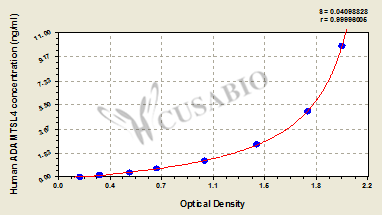
ng/ml OD1 OD2 Average Corrected 10 2.044 1.968 2.006 1.840 5 1.753 1.775 1.764 1.598 2.5 1.415 1.402 1.409 1.243 1.25 1.004 1.084 1.044 0.878 0.625 0.712 0.700 0.706 0.540 0.312 0.523 0.505 0.514 0.348 0.156 0.301 0.312 0.307 0.141 0 0.167 0.164 0.166 -
數(shù)據(jù)處理:
-
貨期:3-5 working days
引用文獻(xiàn)
- METHODS AND SYSTEM FOR DETERMINING THE DISEASE STATUS OF A SUBJECT Price, Andrew.et al,United States Application,2017
產(chǎn)品評(píng)價(jià)

相關(guān)產(chǎn)品
靶點(diǎn)詳情
-
功能:Positive regulation of apoptosis. May facilitate FBN1 microfibril biogenesis.
-
基因功能參考文獻(xiàn):
- A recurrent pathogenic ADAMTSL4 variant is a major cause of early onset autosomal recessive ectopia lentis in a Cook Island Maori population and associated with a common haplotype, suggesting a founder effect. PMID: 28394649
- study reports a novel founder mutation in ADAMTSL4 gene in children of Bukharian Jewish origin presenting with early-onset bilateral ectopia lentis PMID: 26653794
- ADAMTSL4 mutations are the main cause for isolated ectopia lentis with an early onset of symptoms and possible severe ocular complications. PMID: 25975359
- Compound heterozygous c.1783dupT and c. 2594G>A mutations of ADAMTSL4 gene were causative mutations for this family with isolated non-syndromic ectopia lentis PMID: 24802351
- We have confirmed the gene and protein expression of ADAMTSL4 in human ocular tissue. The pattern of expression may suggest further functions of this gene beyond those suggested by its causative role in isolated ectopia lentis. PMID: 23846871
- This is the first detailed report of a possible genetic determinant of craniosynostosis with ectopia lentis. PMID: 22871183
- Patients from a family with ectopia lentis et pupillae (ELP) in four generations have autosomal recessive ELP caused by novel mutations in ADAMTSL4. PMID: 23426735
- Mutations in ADAMTSL4 appear to cause earlier manifestation of ectopia lentis and are associated with increased axial length. PMID: 22736615
- Enhanced fibrillin-1 deposition in the presence of ADAMTSL4 and colocalization of ADAMTSL4 with fibrillin-1 in the ECM of cultured fibroblasts suggest a potential role for ADAMTSL4 in the formation or maintenance of the zonule. PMID: 21989719
- The results emphasize the association of ADAMTSL4 null mutations with isolated ectopia lentis and the presence of a founder mutation in the European population. PMID: 21051722
- Ectopia lentis et pupillae is associated with a number of malformations primarily in the anterior segment of the eye. PMID: 20702823
- This study confirms that homozygous mutations in ADAMTSL4 are associated with autosomal-recessive ectopia lentis in British families. PMID: 20564469
- Herein we show a consanguineous family that carries a novel homozygous splice mutation IVS4-1G>A/IVS4-1G>A in ADAMTSL4 responsible for isolated autosomal recessive ectopia lentis. PMID: 20141359
- Mutations in ADAMTSL4 are responsible for autosomal-recessive simple ectopia lentis and this proteins affectsthe development of the zonular fibers. PMID: 19200529
顯示更多
收起更多
-
相關(guān)疾病:Ectopia lentis 2, isolated, autosomal recessive (ECTOL2); Ectopia lentis et pupillae (ECTOLP)
-
亞細(xì)胞定位:Secreted, extracellular space, extracellular matrix. Note=Colocalizes with FMN1 microfibrils in the eye ECM.
-
組織特異性:Expressed in colon, heart, leukocyte, liver, lung, skeletal muscle, spleen, testis and placenta. Weaker expression in bone marrow, brain tissue, kidney and pancreas. Expression studies in fetal tissues reveal strong expression in heart, kidney, liver, lun
-
數(shù)據(jù)庫(kù)鏈接:
Most popular with customers
-
Human Transforming Growth factor β1,TGF-β1 ELISA kit
Detect Range: 23.5 pg/ml-1500 pg/ml
Sensitivity: 5.8 pg/ml
-
-
-
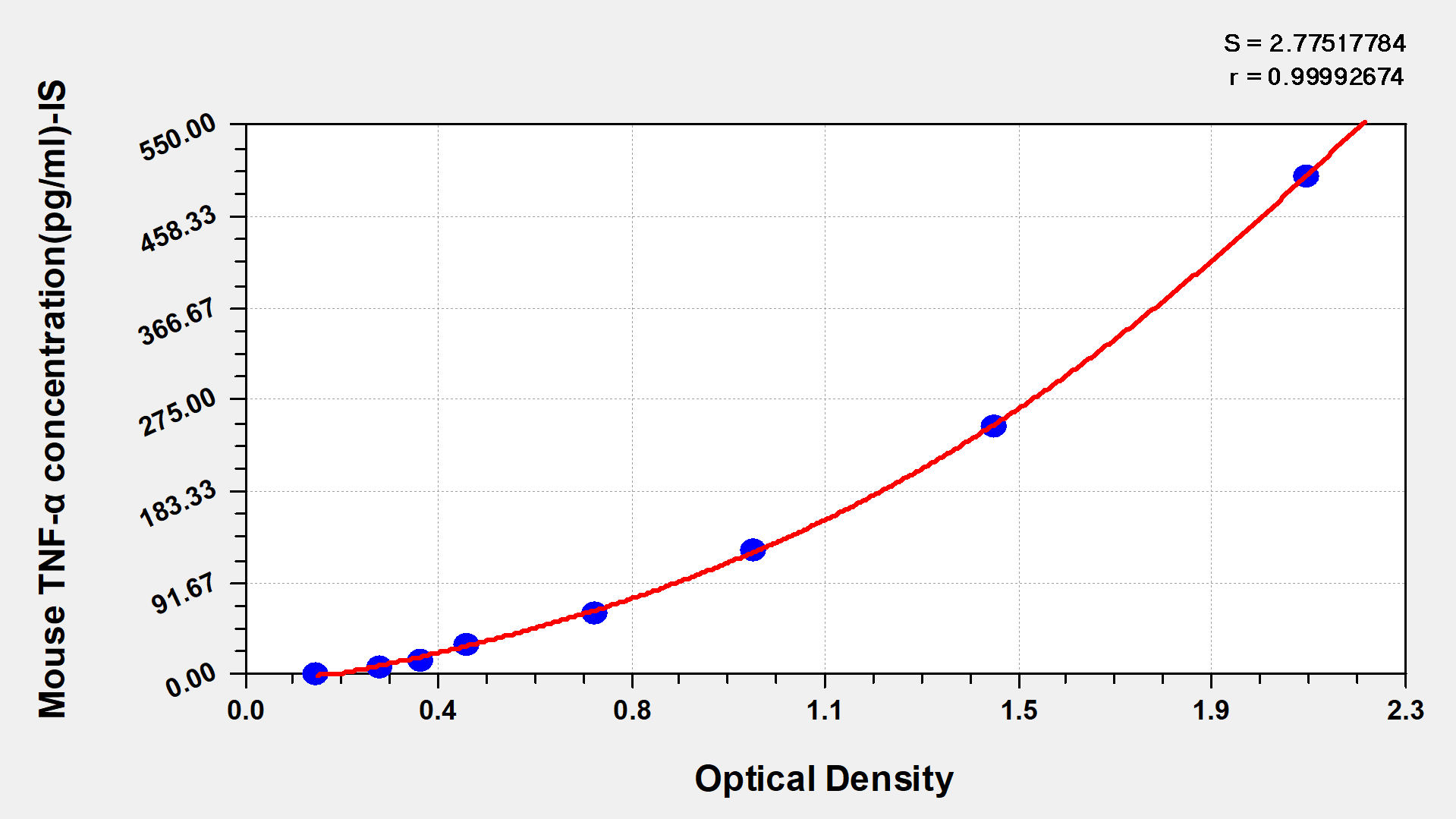
Mouse Tumor necrosis factor α,TNF-α ELISA Kit
Detect Range: 7.8 pg/ml-500 pg/ml
Sensitivity: 1.95 pg/ml
-
-
-
-